
So much can change in a month. Last issue’s Art Law Corner discussed the relatively benign question of judicial costs orders; now we have a full-blown war to contend with. I would be remiss not to respond with some comments on the international rules of war affecting cultural property, a category which can include monuments, archaeological sites, museums and works of art.
Self-evidently, parties to an international conflict must not direct attacks against cultural property. The rule is a cornerstone of the 1954 Hague Convention for the Protection of Cultural Property in the Event of Armed Conflict, negotiated in the aftermath of the Second World War. The countries driving the current conflict have all signed up to this Convention, including Israel (1957), Iran (1959) and the US (2009). The prohibition is also a recognised rule of customary international law, so it should apply even with respect to countries that haven’t signed the Convention, such as the United Arab Emirates.
Unfortunately the rule is qualified by imperative “military necessity”. This can be used as a pretext in certain cases to attack a historic or cultural site. A 1999 protocol to the Convention admirably tried to define and restrict military necessity, but it only binds countries that have ratified that later protocol: the US and Israel never did.
The bodies that assist in the promotion and operation of the Hague Convention are the Committees of the Blue Shield: one international body and numerous national bodies. The US Committee came out with a strongly-worded statement on 4 March calling on parties to “review and reaffirm their treaty obligations”. The committee was particularly worried by statements from US Secretary of War Pete Hegseth. In fact, Hegseth’s words from last September come chillingly to mind, describing the rebranded Department of War as pursuing “maximum lethality, not tepid legality”. The vain hope that this was mere rhetoric (and a bad rhyme) has been laid bare over the past weeks.
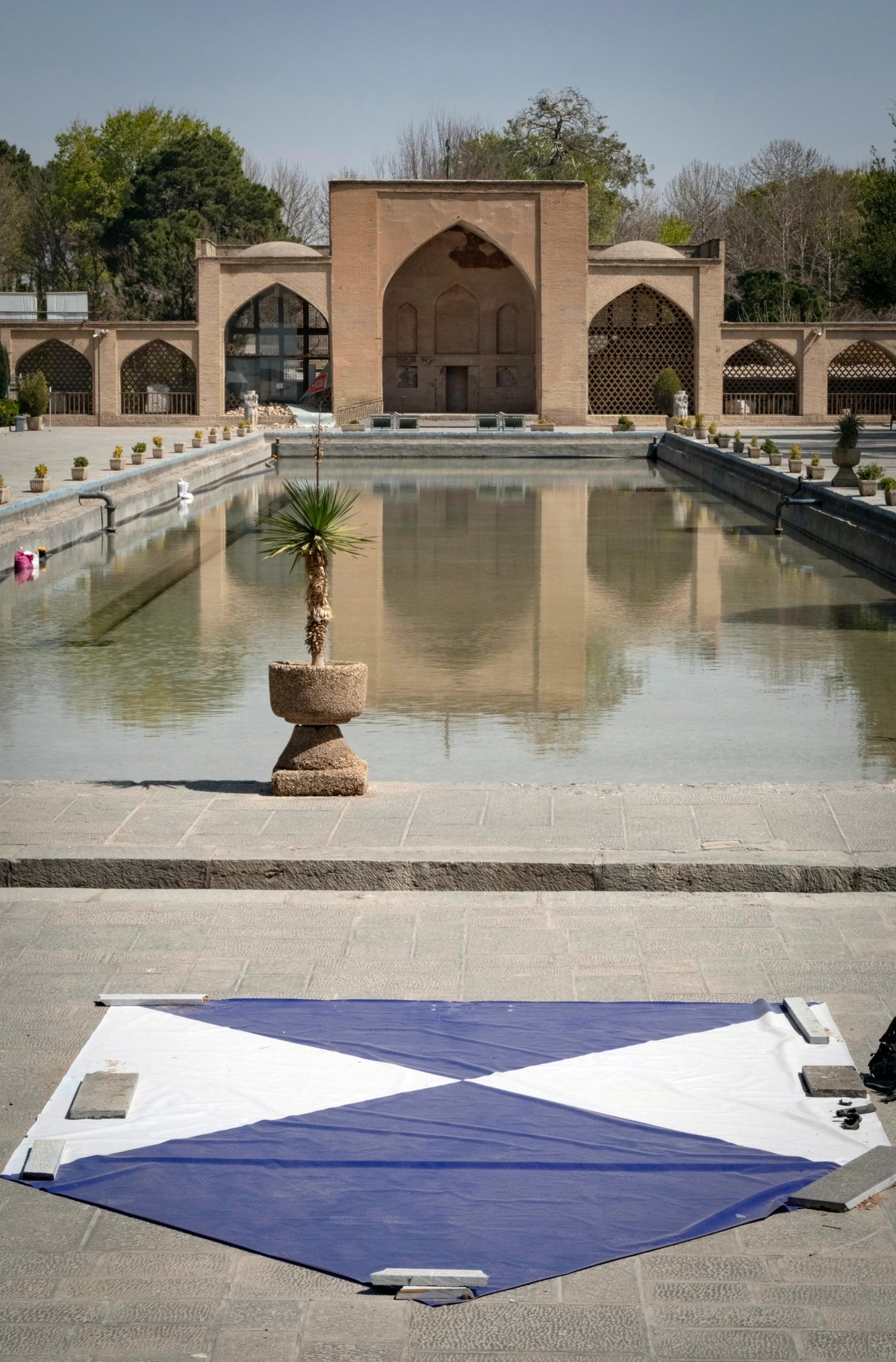
The Blue Shield is the emblem of the Hague Convention. Consisting of interlocking blue and white triangles in the form of a shield, it was intended to be the cultural property equivalent of the Red Cross. Sadly it is not nearly as recognisable: whenever I show the emblem to students and ask them to identify it, I am met with an awkward silence. Nevertheless, the proliferation of Iranian historical sites now marked with enormous canvas Blue Shield emblems visible from the sky is impressive.
The need for absolute immunity
The way for cultural property in this conflict to have absolute immunity, not subject to military necessity, would be to include it on a list of special or enhanced protection under the Convention or its 1999 protocol. Until three years ago, neither list had garnered more than a handful of properties. Ukraine has since listed 27 sites and Lebanon 34 for “provisional” enhanced protection under the protocol. However, the process is cumbersome: for instance, it took 18 months following Russia’s invasion in February 2022 for the Ukrainian sites to be listed. Additionally, non-parties to the protocol (US, Israel, Russia) are not specifically obliged to honour them.
Unesco has more recently come out in support of protecting recognised World Heritage Sites, of which there are 27 in Iran. The international organisation has reportedly shared the coordinates of these sites, and others in the region, with the military powers in the conflict. The hope is that the honour of these countries will ensure that the sites are not attacked.
My own modest proposal would be for an international rule recognising automatic immunity for World Heritage Sites in times of conflict. The only conceivable exception might be for sites adjacent to active state military facilities. Others should never be targeted, including for reasons of military expediency. In the current context, this proposal may sound tepid and legalistic. But sometimes that’s the best we can do in the face of brute force.